
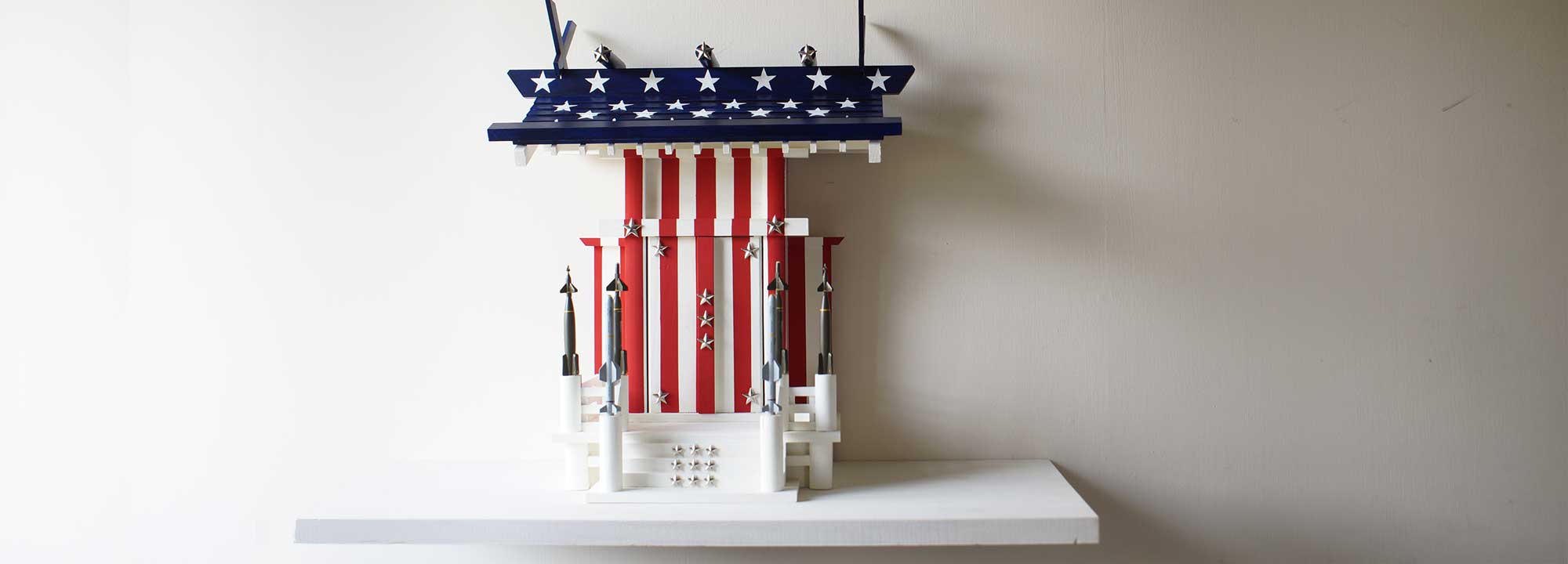
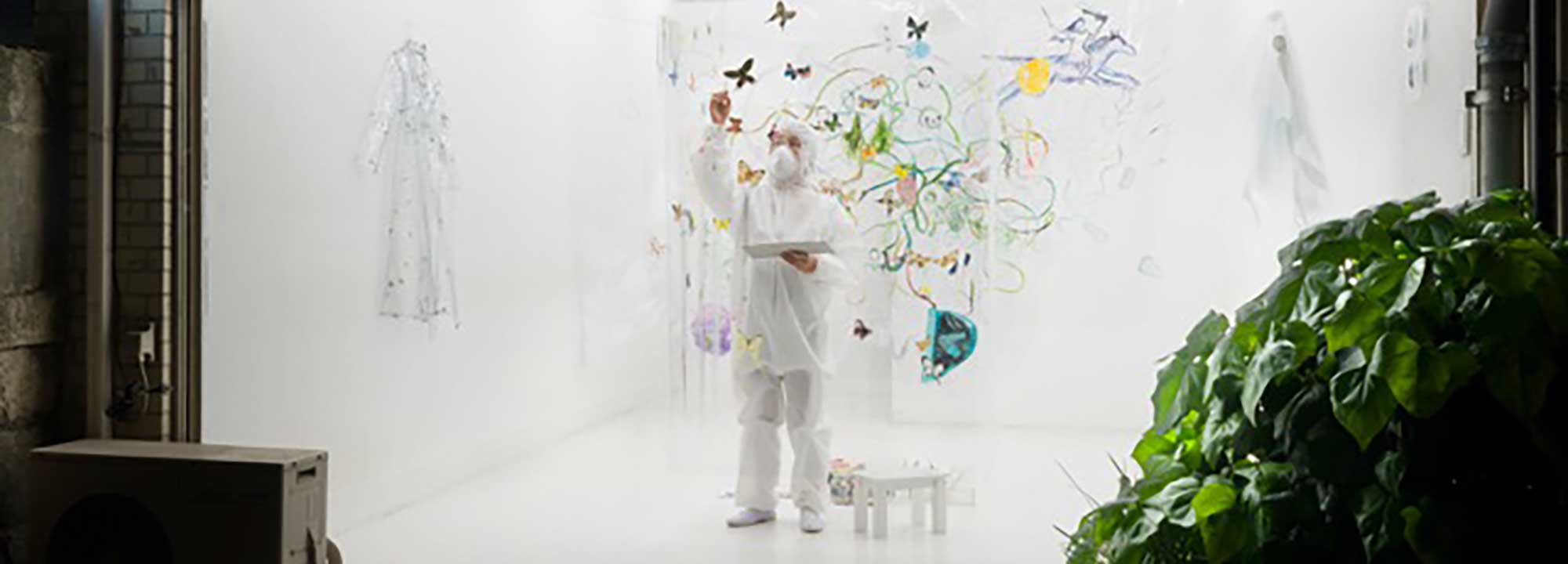
Contemporary art fundamentally opposes war.
Thus, I oppose Japan’s new security legislation.
War creates separation between “we” and “enemies”.
Who are the “enemies” considered as a danger?
What are the profiles of these “enemies,” made into targets for unmanned aerial combat vehicles?
Where do the “enemies” in a state of war come from?
Who really are the “enemies,” positioned as evil to outside of the society?
The imagination of art goes to these “enemies”.
Time and time again, the history of art has praised war.
Not just as a result of unconditional obedience to orders.
A desire for war always lies in humans, which makes mankind’s extinction a superior aesthetic pleasure — “war is beautiful.”
An imperfect animal that senses “élan vital” in battles and killings, humans make war a spectacle.
On the monitor is a war taking place in a “far country”, giving no actual sense of violence and death.
Once distant from it, everyday life continues to go on, as if “the war did not take place”.
On the other hand, art has portrayed each person’s singular death that occurs in war.
It has conveyed how murderous actions thoroughly destroy the human mind.
It has expressed painful memories that afflict the future over many generations.
It has converted the emotion of violence and revenge, which would lead to war, into “lyrical terrorism”.
War creates separation between “we” and “enemies”.
In the midst of dichotomization between justice and evil, “barbarians”, who threaten the nation’s existence, are created.
Divisions, discrimination and dichotomies between different nationals, civilizations, cultures, races, economies and religions.
That is where a collective called “we” arises, automatizing the system of censorship and self-censorship.
The imagination of art goes to “we”.
Japan bears a future to be a neutral country that realizes high-level peace negotiations by thrusting into the thick of grudges, hatred and antagonism.
Proactive contribution to peace can be achieved by strategically taking advantage of Article 9 of the Japanese Constitution.
This must be a historical necessity based on remorse over World War II.
There are unbreakable contracts with the past.
Contemporary art thus fundamentally opposes war.
Signed
Ayako OsanaiYasuto Masumoto
Yaegashi Yoshihi
Koichi Tanibe
Hikaru Fujii
Hitoshi Mori
Jun Kawada
Atsuko Nozaki
Fumio Inoue
Kaori Homma
Shiigi Shizune
NAKAJIMA Yuta
Vincent Vandaele
Kosuke Hatano
Natsuko Kurashige
Hajime Nariai
Hiroki Yamamoto
Satoshi Otsuka
Yayoi Yoshizawa
Yuka Tokuyama
Keiji Saito
Hanae Utamura
Rumiko Hagiwara
Kokatsu Reiko
Masaki Nakayama
Jun Miyagi
Toru Koyamada
Ken Sasaki
Meiro Koizumi
Emi Endo
Masami Kondo
Kazuhito Tanaka
Hiroshi Sugawara
Yuri Shirasaka
Aisuke Kondo
meosai
Sachiyo Honda
Shiro Masuyama
Megumi Shimizu
Satoshi Nakashima
ON megumi Akiyoshi
Yuki Harada
Kazuhiko Yoshizaki
Jun Fukae
Yohei Tomooka
Kaz. Sakurada
Shigeo Arikawa
Satoshi Hashimoto
Manabu Takano
Michiko Tsuda
Toichiro Tanaka
Rika Aki
Naoya Fujita
Yuki Okumura
Yusuke Mitsufuji
Satoshi Uchiumi
Jun Yang
Koki Tanaka
Yukiko Nagakura
Hiroshi Sunairi
Yoshio Shirakawa
Keiko Goto
Satoshi Koganezawa
Ryo Fujii
Katsuhiro Saiki
Migiwa Orimo
Hiromi Takai
Tamaki Kawaguchi